A Deep Dive into Spiritual Ecology Part I

Photo by Bear Guerra
A four-part online course offering a deep dive into the philosophy and practice of spiritual ecology. This course grew out of Kalliopeia Foundation’s Spiritual Ecology Fellowship.
With Emergence Magazine — July 2020 & October 2020
2020 continues to be a year marked by uncertainty. Change is inevitable. Something is coming to an end, and something new is emerging. How will we be part of this change? How can we put our values into service for both human and non-human life? What are the inner and outer dimensions of the work of reuniting people, the living world, and the sacred? How can the teachings of spiritual ecology enable us to participate in re-weaving these threads?
Due to its immense popularity, we offered two iterations of A Deep Dive into Spiritual Ecology. It was attended by upwards of 500 participants in total.
OVERVIEW
The course was oriented around four core modules, each connecting to an Emergence Magazine essay or story, forming the basis for the enquiry and themes.
Session included guided meditation, talks, small and big group discussion, reflective journalling and other creative exercises. In between sessions, participants were offered readings and practices to further deepen their enquiry into the themes.
Part 1: Origins
The first module offered space to explore our own ‘spiritual ecology origins story’, inviting the idea that regardless of our knowledge or experience of spiritual ecology, we each have a unique and intimate connection to it:
“In spite of our forgetting, there is still a part of us that is deep and intimate with the world. We remember it by feel. We experience it as a murmur in the night, a longing and restlessness we can’t name, a yearning that tugs at us. For it is only recently, in earth time, that the severing of the connections between people and land have taken place. Something in our human blood is still searching for it, still listening, still remembering.”
We each have our own stories of longing, searching, remembering this wholeness with the living world, in the words of Linda Hogan, “a longing to become whole and connected with the earth.” Through a series of journaling and discussion prompts, we reflected on this theme, grounding ourselves in the stories that give rise to our own intrinsic connection to spiritual ecology.
We also reflected on the importance of ‘facing our collective origins’, and the importance of consciously acknowledging the forces that destroyed — and continue to destroy — a spiritual relationship with the earth and the indigenous cultures and communities that held this living wisdom. Each of us has our own ancestral connections to these histories, and facing these shadows and asking what it means for us to take responsibility for them is an important part of the work of healing.
PART II: Principles
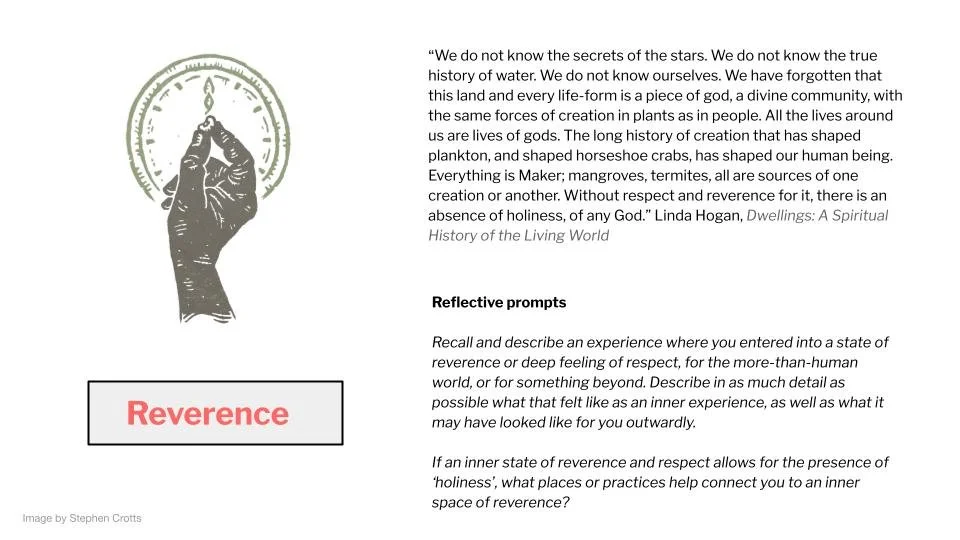
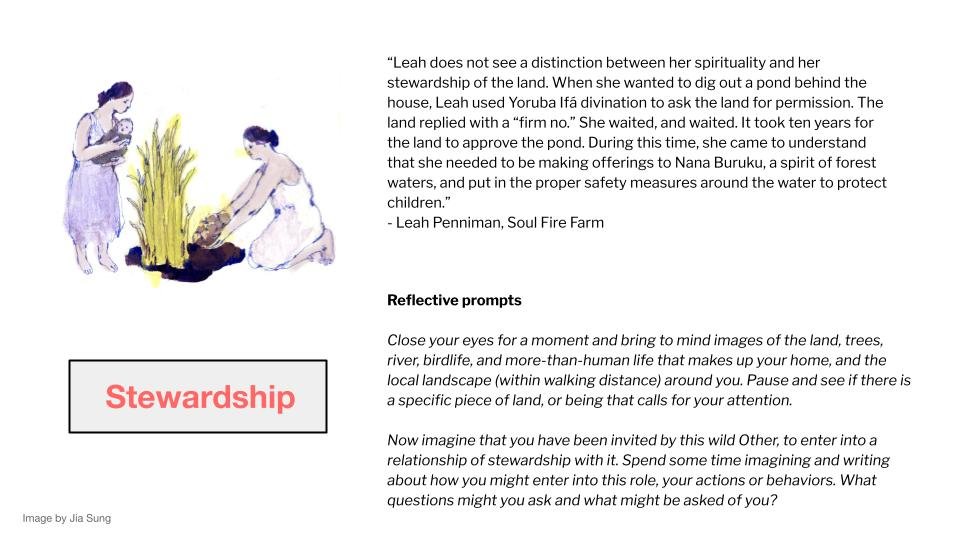
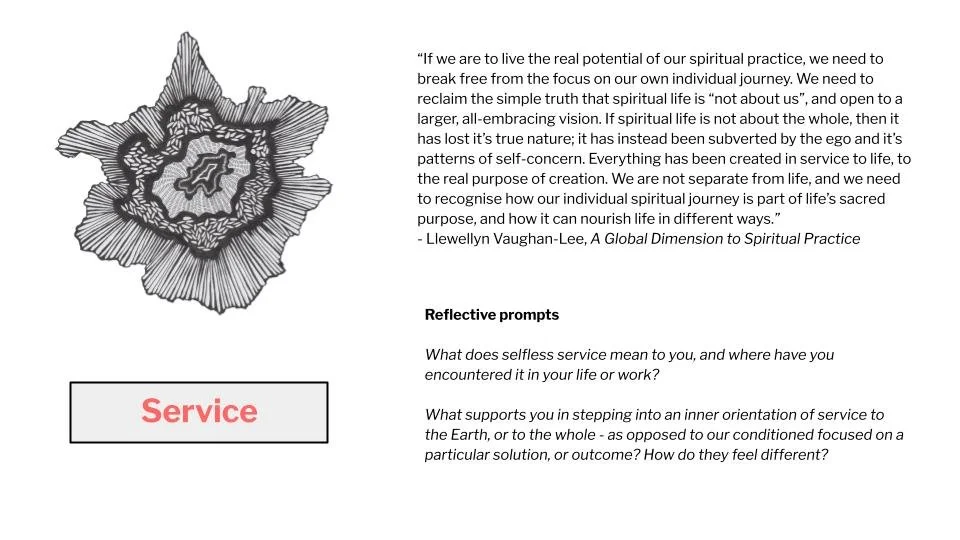
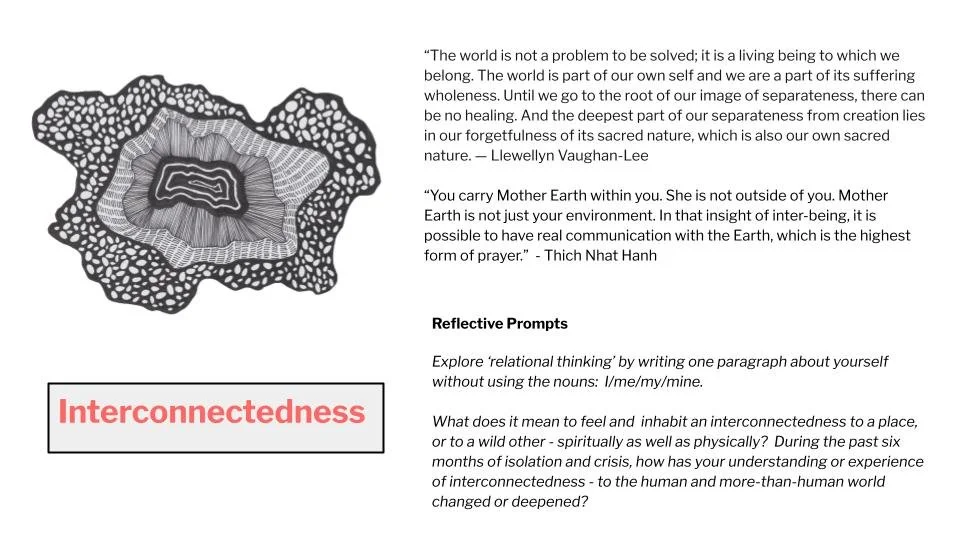
In this module, we explored the relationship between spiritual and ecological renewal and reflected on four universal spiritual principles that can guide us in rebuilding our inner relationship with the living world. These principles are: interconnectedness, reverence, service and guardianship.
““Such spiritual principles for living did not come from logic or thought but from a much deeper source of wisdom, which our Unangan culture referred to as the “heart.” When Unangan Elders speak of the “heart,” they do not mean mere feelings, even positive and compassionate ones. “Heart” refers to a deeper portal of profound interconnectedness and awareness that exists between humans and all living things. Centering oneself there results in humble, wise, connected ways of being and acting in the world. ”
Much of this inner restoration has to do with nurturing new ways of being that allow us to re-enter into a sacred relationship with the living world, which can restore a sense of respect and honour. As expressed by Larry in the quote above, these spiritual principles are a deeper source of wisdom that is universal and can be found within all wisdom traditions across time and place.
We reflected on these four core principles through storytelling, journaling and group discussion.
PART III: Practices
Creating new cultures of reciprocity and reverence with our Earth begins with integrating this way of being within our own lives first. Spiritual ecology practices are simple, personal, daily rituals that can help anchor us and nourish the seeds of spiritual ecology, which, over time, can become reflected in our outer work and brought into our wider communities.
In this module, we considered some qualities that can help us in creating a sacred container for our practice, including: offering, attention and attentiveness, intention, compassion, listening and commitment.
We reflected on practices which are already present in our daily lives and examples of new ones we feel inspired to integrate:
What does SE practice mean to you? What practices do you already have in your life?
What is your next step in deepening intimacy, kinship and revelation with the more-than-human world? How or where do you feel a curiosity or longing to offer your attention and practice?
What are your biggest challenges or obstacles to committing to a regular practice?
Finally, we explored the bigger dimension of our practice, including how, in the words of ecologist David Haskell, they are invitations to belonging, returning us to our real home and community. They also invite us to witness the greater story taking place at this moment in time; when we slow down and are present enough to witness the living world and what is changing, we experience stories of resilience, loss, change, and adaptation. These are stories worth telling.
Our practice can nourish the earth in ways that indigenous people have always known the power of ceremonies to nourish not only the outer but also the inner life of the living world and humans.
“ Everywhere people are talking about the desperate need for a new story. We suggest that the stories worth attending to arise from the earth itself. We don’t need commentary about the earth, we need disclosures FROM the earth.”